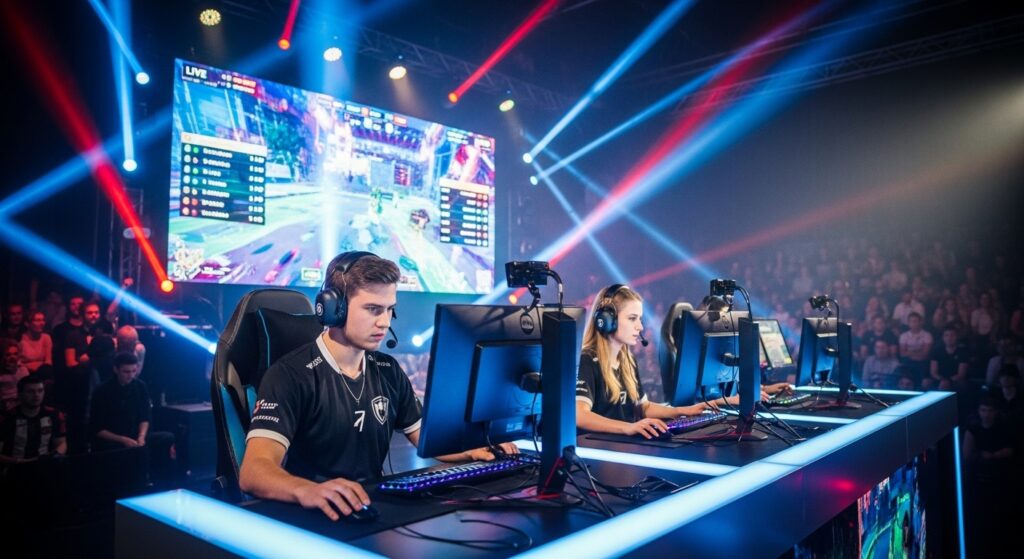
Introduction: The Birth of a Digital Revolution
Esports, short for electronic sports, represents one of the most fascinating cultural shifts of the 21st century. What started as casual competitions between friends has evolved into a multi-billion-dollar global industry, rivaling traditional sports in popularity, audience size, and revenue. With players turning into celebrities, tournaments filling stadiums, and brands investing heavily in sponsorships, esports has transcended its roots to become a legitimate global phenomenon.
This revolution was not born overnight. It grew from the merging of technology, community, and competition—a perfect storm that transformed gaming from a pastime into a career, a spectacle, and a shared identity for millions around the world.
The Origins: When Gaming Became Competitive
The earliest seeds of esports were planted long before high-speed internet or powerful gaming PCs existed. In the late 1970s and early 1980s, arcade gaming was the first battleground for high scores. Titles like Space Invaders and Donkey Kong gave rise to friendly rivalries and early tournaments. The idea was simple—achieve the highest score and etch your name into history.
The first known large-scale video game competition, the 1980 Space Invaders Championship, attracted over 10,000 participants across the United States. It was a landmark event, proving that gaming could draw crowds and unite people under a shared passion for digital competition.
As technology advanced, personal computers and home consoles brought multiplayer gaming into households. Titles such as Street Fighter II, GoldenEye 007, and StarCraft became the early training grounds for the first generation of competitive gamers.
The Internet Era: A New Battlefield
The 1990s ushered in the internet age, fundamentally transforming how players interacted. With online connectivity, geography no longer limited competition. Players could now test their skills against anyone, anywhere, anytime.
Games like Quake, Counter-Strike, and StarCraft: Brood War became the pillars of early online competition. South Korea, in particular, embraced the trend with unmatched enthusiasm. The country’s technological infrastructure and cultural acceptance of gaming paved the way for professional leagues, televised matches, and even government-backed esports initiatives. South Korea’s dominance in titles like StarCraft laid the foundation for modern esports professionalism.
In the West, LAN (Local Area Network) tournaments became the lifeblood of the scene. Events like QuakeCon and the Cyberathlete Professional League (CPL) gathered players in massive halls filled with PCs, cables, and pure adrenaline. The concept of competitive gaming as a spectator sport began to take shape.
The 2000s: Esports Gains an Identity
The early 2000s marked a pivotal point where esports began to establish its unique identity. With improved internet access, better hardware, and growing communities, competitive gaming became more organized and structured. Leagues and organizations began to emerge, giving players platforms to showcase their talents on a global stage.
During this time, games like Counter-Strike 1.6, Warcraft III, and Halo 2 defined their respective competitive scenes. Players started forming teams, gaining sponsorships, and even traveling internationally to compete. Major events like the World Cyber Games and the Electronic Sports World Cup legitimized esports as a serious pursuit.
Online streaming was still in its infancy, but the rise of platforms like YouTube and later Twitch would completely change how fans consumed gaming content. Players who once competed in obscurity could now broadcast their matches to thousands of viewers around the world.
The 2010s: Esports Enters the Mainstream
If the 2000s built the foundation, the 2010s launched esports into the stratosphere. With platforms like Twitch, YouTube Gaming, and social media, esports gained visibility on a scale previously unimaginable. Viewership exploded, and so did investment.
Titles such as League of Legends, Dota 2, Counter-Strike: Global Offensive, Overwatch, and Fortnite became the giants of the scene. Each had its own ecosystem, tournaments, and fanbase. Riot Games’ League of Legends set the standard with its annual World Championship, filling stadiums like the Staples Center and attracting millions of online viewers. Meanwhile, Valve’s Dota 2 International shattered prize pool records year after year, reaching tens of millions of dollars through community crowdfunding.
The era also saw the rise of esports organizations that functioned like traditional sports franchises. Teams such as Fnatic, Cloud9, Team Liquid, and T1 became global brands, boasting rosters across multiple games and massive fan followings.
The Power of Streaming and Content Creation
One of the biggest accelerators of esports growth was live streaming. Twitch transformed the industry by making gaming content accessible 24/7. Fans could watch professional players, learn strategies, and engage directly with their favorite personalities. This democratization of viewership gave rise to new careers—not just professional players, but streamers, analysts, casters, and content creators.
The blending of esports and entertainment became inevitable. Streamers who began by casually playing games started hosting massive tournaments, brand collaborations, and charity events. Esports no longer belonged only to the hardcore competitive crowd—it became entertainment for everyone.
Esports as a Career: From Passion to Profession
In the early days, professional gaming was often dismissed as a hobby. Parents were skeptical, schools didn’t recognize it, and few believed one could earn a living through gaming. But the landscape has drastically changed.
Today, professional players can earn substantial salaries, sponsorships, and prize money. Top-tier players often live in team houses, train with coaches, nutritionists, and psychologists, mirroring traditional athletic setups. Organizations offer structured contracts, benefits, and international exposure.
Beyond players, entire ecosystems of jobs have formed around esports—casters, analysts, event organizers, marketing teams, content producers, and data analysts. Universities even offer esports scholarships, and governments recognize competitive gaming as an official sport in several countries.
The Global Reach: Uniting Cultures Through Competition
One of esports’ greatest strengths lies in its universality. Unlike many traditional sports that are geographically dominant, esports transcends cultural and linguistic barriers. A player from Brazil can compete against someone from Sweden, watched by fans in Japan and South Africa—all in real time.
Major tournaments attract audiences from every corner of the globe. The international nature of esports has fostered global communities bound by passion, respect, and competition. Online friendships and rivalries blossom across borders, proving that digital arenas can unite people more than divide them.
The Economics of Esports: A Billion-Dollar Industry
Esports has grown into a multi-billion-dollar industry encompassing multiple revenue streams—sponsorships, media rights, merchandise, advertising, and ticket sales. Major brands like Intel, Red Bull, and Coca-Cola have invested heavily, recognizing esports’ unmatched engagement with younger demographics.
Prize pools continue to rise, with games like Dota 2 offering tens of millions in rewards, while Fortnite made headlines with its massive World Cup event. Esports organizations operate much like traditional sports teams, signing players, negotiating sponsorships, and building fan loyalty through content and branding.
The introduction of franchised leagues, such as the Overwatch League and Call of Duty League, brought additional structure and long-term investment. These leagues feature city-based teams, mirroring traditional sports and creating regional loyalty within the esports community.
Esports and Technology: Innovation Driving Growth
Esports is deeply intertwined with technology. High-performance hardware, fast internet, and advanced software have all fueled its growth. Virtual reality (VR), augmented reality (AR), and cloud gaming are poised to further transform the industry, offering immersive experiences for both players and spectators.
Broadcast technology has also evolved, integrating real-time data visualization, augmented overlays, and interactive viewing experiences. Fans can now track player stats, switch camera angles, and even interact with live broadcasts in ways traditional sports can’t yet match.
Artificial intelligence and analytics are becoming central to esports strategy. Teams analyze gameplay data to refine tactics, optimize team compositions, and scout opponents. The line between gaming and science continues to blur as technology redefines competition.
The Role of Community and Fan Culture
Esports thrives on its communities. Fans are not just spectators—they are participants. They create fan art, analyze games, fund prize pools, and support players through streaming platforms. Online forums, Discord servers, and social media groups form the heartbeat of every game’s competitive scene.
Fan loyalty in esports is powerful. Supporters follow teams across tournaments, purchase merchandise, and attend live events. They create memes, celebrate victories, and rally behind underdogs with the same passion seen in football or basketball fans.
The interactive nature of esports fosters a two-way relationship between players and fans. Unlike traditional athletes who are often distant figures, esports players regularly engage with fans through streams, chat interactions, and social media, creating authentic connections that deepen loyalty.
Challenges Facing Esports
Despite its meteoric rise, esports faces its fair share of challenges. Player burnout is one of the most pressing issues, as constant travel, training, and public scrutiny take a toll on mental health. With the industry still young, support structures are improving but not yet perfect.
Another concern is the lack of standardization. Each game operates under its own rules, leagues, and formats, making it difficult to create a unified global system. Furthermore, issues such as match-fixing, cheating, and performance-enhancing substances have occasionally marred the integrity of competitions.
There are also debates around inclusivity and representation. While progress has been made, esports remains male-dominated, and efforts to increase diversity and accessibility continue across the industry.
Esports in Education and Youth Development
Esports has found its way into schools and universities around the world. Educational institutions are embracing competitive gaming as a tool for developing teamwork, communication, and strategic thinking. Esports programs teach students not only gameplay but also event management, broadcasting, and marketing.
Scholarships for esports players have become common, especially in North America and Asia. These programs legitimize gaming as an academic and athletic pursuit, opening doors for future careers in both play and production.
Beyond competition, esports education nurtures digital literacy, problem-solving, and resilience—skills that are invaluable in an increasingly digital world.
The Future of Esports: Where Do We Go from Here?
The future of esports is incredibly promising. As technology evolves, so will the ways people play, watch, and interact. Mobile gaming is already expanding the reach of esports, particularly in regions where PCs and consoles are less accessible. Titles like PUBG Mobile and Mobile Legends have become cultural phenomena in Asia, drawing millions of active players and viewers.
Virtual reality esports could redefine the concept of physical gaming, merging athletic movement with digital skill. Meanwhile, blockchain and digital collectibles are beginning to reshape how fans support teams and own virtual assets.
Traditional sports organizations are also joining the esports world. Football clubs, basketball teams, and even Olympic committees are investing in digital competition, blurring the boundaries between physical and virtual sport.
Conclusion: Esports as the Sport of the Digital Age
From dimly lit LAN cafes to roaring stadiums filled with fans, esports has come a long way. It embodies the passion, competition, and community that define all great sports—but with the unique power of technology to connect the world instantly.
Esports is more than gaming; it is culture, innovation, and human connection expressed through pixels and precision. It continues to inspire millions of players and fans to chase greatness, not on a field or court, but in the vast digital arenas where reflexes meet strategy and passion meets purpose.
As we move further into the digital century, esports stands not as a trend, but as a testament to how far gaming has come—and how much further it will go.